
Communities & Ghost Towns of Allen Township
Throughout the 1800s and early 1900s, Allen Township was home to several small communities. Some developed into local centers for schools, churches, mail, and trade, while others were little more than crossroads or neighborhoods. Over time, changes in transportation, population, and industry caused many of these places to fade from the map.


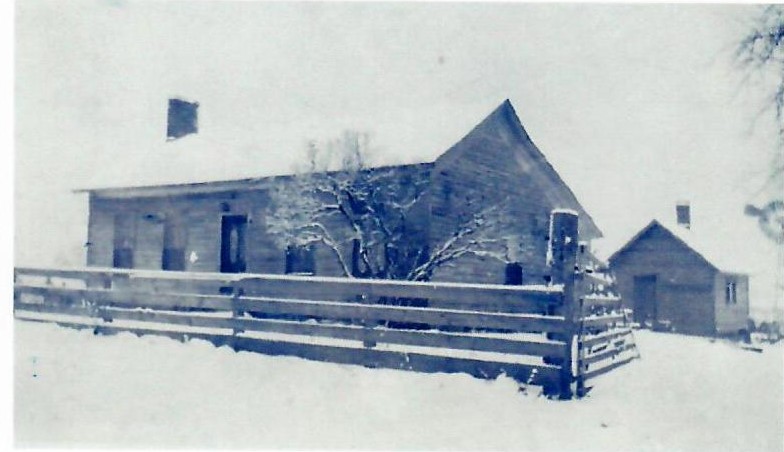
Lentz Family Home in Allen Township
Allen Center
Allen Center developed as the township’s civic and institutional center.
The first known business at Allen Center was an ashery, operated a few years before Joel Eaton purchased five acres of land between 1848–1849. This land was platted into several lots, forming the village.
A U.S. Post Office was established on February 14, 1851, with Reuben Foote serving as the first postmaster. The post office operated until February 3, 1863.
Key developments in Allen Center included:
- Allen Center Baptist Church organized in 1854; a frame church was built in 1872 and the congregation remains active today
- General store established by Barnet Bennett in 1862, later sold to Jacob Painter, who closed the business by 1875
- Protestant Methodist Church organized in 1863; disbanded by 1875
- Allen Township Hall, which continues to serve township government
In 1912, a school building was erected at Allen Center, and in 1924, the Allen Township Rural School District was chartered. In 1949, the district was incorporated into the Marysville School District.
Pottersburg / Pottersburgh
Pottersburg was Allen Township’s most developed village, growing rapidly due to the railroad.
The community began as a stop on the Atlantic & Great Western Railway in 1864, with Captain Jonas Cline appointed as ticket agent. In 1869, Cline built a sawmill, the first house (for Abel Lary), a home for himself, and a small general store.
The town was formally surveyed on February 18, 1869, by Andrew S. Mowry for David A. Williams and George F. Bennett, and recorded on May 1, 1869. An addition known as Railroad Street was surveyed on October 22, 1872, by Thomas Cowgill for W. Armstrong.
Notable features of Pottersburg included:
- U.S. Post Office established June 29, 1869 (originally Pottersburgh); renamed Pottersburg in 1894
- Railroad depot and telegraph office constructed by 1872
- Methodist Episcopal Church organized in 1877, with a frame church built in 1880
- Two-story schoolhouse built between 1881–1882
The Pottersburg Post Office operated until October 30, 1926. Today, only a few homes remain where the village once stood.

Pottersburg Church
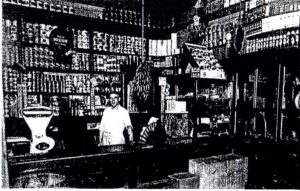
Glen Cline’s Store
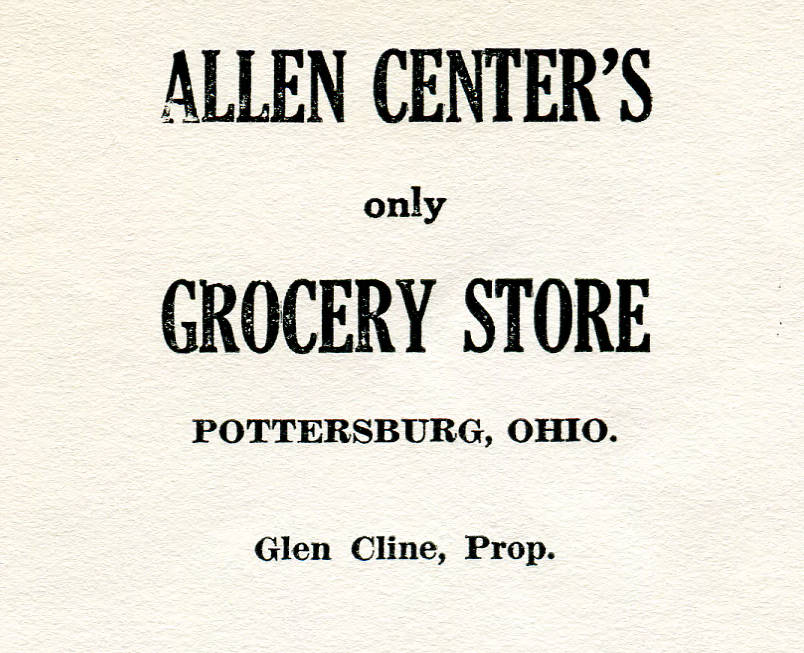
Advertisement for Pottersburg Grocery
Coberly’s
Coberly’s was a small village located at the present-day intersection of Inskeep-Cratty Road and North Lewisburg Road. It once contained both a school and a post office, and provided several township officials during Allen Township’s early years.
Stringtown
Stringtown was likely more of a neighborhood than a formal village. It consisted of several homes and a schoolhouse, but no evidence of a post office has been found.
Other Historic Places
- Bear Swamp – a wetland area in the northeast part of the township
- Indian Fields – located along the Big Darby Creek, approximately two miles above Milford Center; known as a Native American camping and cultivation site prior to settlement
Past U.S. Post Offices in Allen Township
- Allen Center – February 14, 1851 to February 3, 1863
- Buck Run – April 18, 1829 to December 29, 1830; reopened April 3, 1832 to September 5, 1834; reopened June 3, 1839 to March 8, 1843
- Pottersburgh – June 29, 1869 to May 31, 1894
- Pottersburg – June 1, 1894 to October 30, 1926
One-Room Schools
Allen Township was once served by numerous one-room schoolhouses, including: Henpeck, Stringtown, Greenwood, Railroad, Little Red Schoolhouse, Buck Run, Allen Center, Connolly, Pottersburg, and one unidentified location.